Pype Hayes Park Pool Wildlife Deaths: Timeline of Resident Reports, Council Response and Councillor Action
By Cllr Danny Carter · 23 September 2026
Overview
During September 2026, serious concerns were raised with me by local residents about the deaths and disappearance of waterfowl at Pype Hayes Park pool.
Residents reported dead ducks, a substantial reduction in a well-known family of swans and cygnets, concerns about the condition of the water, and later concerns about what one resident believed to be a blue-green algae bloom.
I formally escalated the matter to Birmingham City Council, asking for an urgent environmental and wildlife investigation, information about water-quality and disease monitoring, and a joint site visit.
The Council subsequently advised that Pype Hayes Park was being affected by avian botulism, and explained the environmental conditions which it believed had contributed to the outbreak.
The following is a chronological account of the correspondence and action taken.
Timeline
10 September 2026, 10:54am — First resident report received
Local resident Karen Middleton contacted me through an email headed "Pype Hayes Park — dead wildlife in lake".
She reported that bird life on the Pype Hayes lake was dying. In particular, she said that a family consisting of two adult swans and three cygnets had been reduced to just one swan and one cygnet.
She also reported that numerous ducks had been seen dead in the lake over the preceding weeks and said these incidents had been reported through the Government reporting system.
The resident expressed concern that there appeared to be a problem with the water affecting the wildlife and asked for the matter to be investigated.
This was a resident's report and observation at this stage. It was not yet a diagnosis of the cause of the deaths.
10 September 2026, 12:27pm — I formally escalate the wildlife deaths to Birmingham City Council
Following that report, I sent "Urgent Investigation Request – Reported Wildlife Deaths at Pype Hayes Park Lake" to Environmental Health and Parks & Green Spaces.
My correspondence set out the reported reduction in the swan family and the reported deaths of ducks. I asked Environmental Health to assess urgently whether there was evidence of contamination or other environmental factors affecting the lake. I also asked Parks & Green Spaces' wildlife team to investigate the reported deaths and inspect the site for any issues affecting wildlife health and welfare.
Importantly, I requested:
- A joint site visit involving Environmental Health and Parks & Green Spaces;
- An opportunity for me to meet officers at Pype Hayes Park;
- Details of investigations already undertaken;
- Information about any water-quality testing;
- Details of wildlife-disease monitoring;
- Information concerning previous reports of wildlife deaths; and
- That the matter be treated as a priority.
My intention was to establish what was happening, what evidence the Council possessed, and what immediate measures could be taken to protect wildlife and reassure residents.
10 September 2026, 12:27pm — Environmental Health acknowledges the report
The Council's Environmental Health system responded to confirm: "We have received your email. Many thanks."
The acknowledgement reproduced my escalation and the original resident correspondence, providing a record that the issue had been formally submitted to the Council.
11 September 2026, 12:51pm — Enquiry referred internally
The Environmental Health team subsequently referred the request onwards, asking colleagues for assistance with the Pype Hayes Park wildlife enquiry.
11 September 2026, 1:20pm — Animal Health & Welfare responds
Vikki Allwood, Senior Animal Health & Welfare Officer within Birmingham City Council's Regulation & Enforcement service, responded to confirm that Parks colleagues were aware of the ongoing wildlife issues at Pype Hayes Park and that the matter was being dealt with.
She explained that she had spoken to Steve Hinton, who would provide a further update.
11 September 2026, 3:47pm — Council identifies avian botulism
A detailed response then came from Steve Hinton, Ranger Services Manager within Birmingham City Council's Parks and Nature Conservation service.
The Council's response stated: "Pype Hayes Park is currently being affected by Avian Botulism."
This was the first substantive explanation in the correspondence for the waterfowl deaths.
The Council explained that avian botulism is associated with toxins produced by Clostridium botulinum Type C. According to the Council's response, when those toxins build up in birds they can cause flaccid paralysis, often resulting in death.
The Council also stated that testing for avian botulism was difficult and could no longer be carried out in the UK, with samples requiring testing in Europe.
Council's explanation of conditions at Pype Hayes
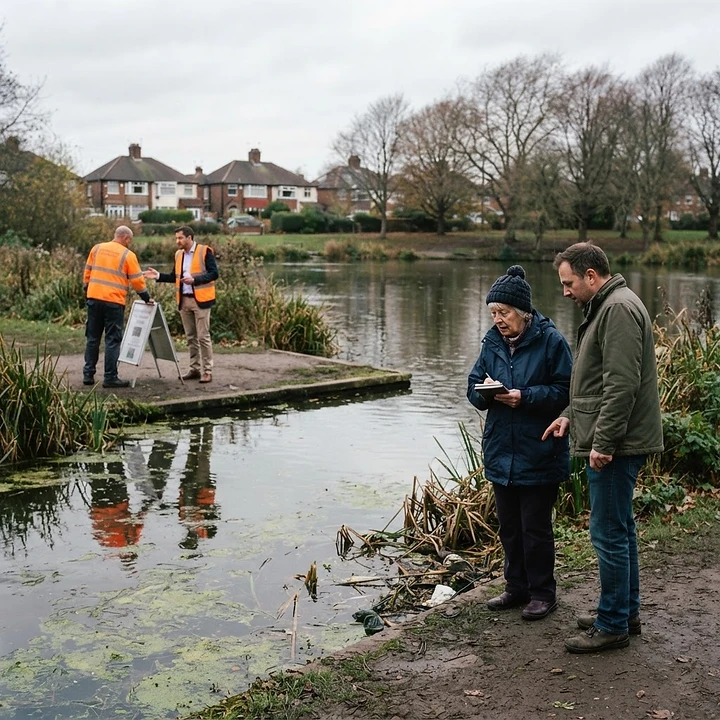
The Council described Pype Hayes Park pool as a typical urban eutrophic pool. Its response identified characteristics including:
- Shallow depth;
- No through-flow from neighbouring watercourses;
- Nutrient-rich conditions; and
- Fluctuating summer water levels.
According to the Council, the eutrophic characteristics of the pool, high summer temperatures and drought conditions had resulted in oxygen-poor conditions and increased Clostridium botulinum activity and associated toxins.
The Council said this had resulted in an outbreak of avian botulism and the loss of waterfowl at Pype Hayes Park.
The Council also advised that it considered the human-health risk associated with avian botulism Type C to be very low.
Wildlife contractor and RSPCA involvement
The Council advised that Parks had engaged a wildlife contractor to collect and dispose of bird carcasses from five pools affected by avian botulism.
According to the response, this arrangement had been operating since July, with collections at Pype Hayes taking place during the preceding three weeks.
The Council said that where live sick birds were discovered, RSPCA colleagues had been assisting.
Residents were specifically advised not to retrieve dead birds themselves. The Council asked that dead birds be left where they were found and reported to Birmingham City Council, so that contractors could collect them.
The contractors were also recording the locations, species and numbers of dead birds and arranging secure disposal.
At the time of the 11 September response, the Council estimated that the effects of the outbreak could continue well into October, given the temperatures and rainfall conditions prevailing at that point.
13 September 2026, 3:17pm — Further resident concerns about possible algae bloom
The issue did not end with the Council's avian botulism response.
On 13 September, another resident, Emma Baldwin, contacted me under the subject "Algae Bloom at Pype Hayes pond".
Emma Baldwin described what she believed to be a toxic blue-green algae bloom. She reported that a male swan and two cygnets had disappeared and were presumed dead, leaving one female swan and one cygnet. She also raised concerns about the appearance and behaviour of the surviving birds and requested urgent action.
Crucially, these statements were the resident's observations and concerns, rather than a Council-confirmed diagnosis of blue-green algae.
Emma Baldwin asked that warning signs be erected around the pool and that relevant agencies and wildlife rescue services be involved in assessing the surviving birds.
13 September 2026, 6:08pm — I escalate the new evidence and public-safety concerns
That evening I sent a further formal escalation, "Urgent Action Requested: Pype Hayes Park Pool Wildlife Deaths, Potential Algae Bloom and Public Safety Concerns".
I wrote to Steve Hinton and Simon Needle, copying the resident into the correspondence so that officers could contact her directly if further information was required.
I acknowledged the Council's earlier explanation concerning avian botulism, but made clear that the latest observations created further questions about the current water conditions, welfare of the surviving birds and residents' concerns about possible algae.
I therefore requested urgent consideration of:
- A site inspection of the pool at the earliest opportunity.
- Assessment of current algae levels and whether further environmental investigation was required.
- Confirmation of warning signage, and installation of appropriate signs if these were not already present.
- Assessment of the welfare of the remaining swan and cygnet.
- Confirmation of ongoing monitoring arrangements.
- Clarification of further measures being taken to mitigate risks to wildlife, park users and domestic animals.
- Direct engagement with the resident if officers required further information about conditions observed at the site.
I concluded by requesting that the situation be treated urgently and that a written update be supplied explaining the Council's assessment and any further action being undertaken.
Position as at 23 September 2026
The correspondence establishes an important distinction between the different issues being reported.
- The Council's stated explanation: Birmingham City Council advised on 11 September that Pype Hayes Park was experiencing avian botulism, which it said had led to the loss of waterfowl.
- Residents' subsequent concern: Emma Baldwin separately reported what she believed was a blue-green algae bloom and raised concerns about the surviving birds and public/dog safety.
- My subsequent action: I asked Council officers to investigate those additional concerns, assess algae levels, check warning signage, assess the remaining birds and provide details of ongoing monitoring and further action.
The correspondence retrieved for this report does not contain a later substantive Council response to that 13 September escalation. I therefore do not want to represent the resident's algae concerns as confirmed by the Council, or claim that the additional actions requested on 13 September have been completed without evidence of that in the correspondence reviewed.
That distinction is important for an accurate and transparent public record.
Key dates at a glance
- 10 September, 10:54am: Karen Middleton reports deaths and losses among swans, cygnets and ducks.
- 10 September, 12:27pm: I formally escalate the matter and request an urgent investigation and joint site visit.
- 10 September, 12:27pm: Environmental Health acknowledges receipt.
- 11 September, 12:51pm: Environmental Health refers the enquiry onwards.
- 11 September, 1:20pm: Vikki Allwood confirms Parks is aware and the matter is being dealt with.
- 11 September, 3:47pm: Steve Hinton provides the substantive Council response identifying avian botulism and explaining the wildlife-management response.
- 13 September, 3:17pm: Emma Baldwin reports further concerns about suspected blue-green algae, surviving birds and public safety.
- 13 September, 6:08pm: I escalate these additional concerns and request inspection, algae assessment, signage checks, wildlife assessment, monitoring information and further action.
- 23 September: This public chronology records the correspondence and position evidenced by the material reviewed above.
My commitment to Pype Hayes residents
Residents were absolutely right to bring the wildlife deaths at Pype Hayes Park to my attention.
When concerns of this seriousness are raised, my approach as the elected Member for Pype Hayes is to put those concerns directly to the responsible Council services, request evidence and answers, and ensure there is a clear record of what has been reported and what action has been requested.
This chronology demonstrates that resident concerns were formally escalated, that the Council subsequently identified avian botulism as affecting Pype Hayes Park, and that when further concerns were raised about the condition of the water and possible algae, those concerns were escalated again rather than being treated as resolved.
I will continue to advocate for clear information, appropriate action and transparency for residents on issues affecting Pype Hayes Park.
Councillor Danny Carter
Member for Pype Hayes
Birmingham City Council
Have Your Say
Have you noticed changes to the wildlife at Pype Hayes Park? Seen dead or sick birds, or concerns about the water? Report it through the ward report tool at dannycarter.org.uk so I can escalate it. The more residents who speak up, the harder we are to ignore.
Do not touch dead or sick birds. Report them to Birmingham City Council so contractors can collect them safely.
Resident comments
Log in or create an account to share your view on this post.
No comments yet — be the first to share your view.